
Sparks are flying, steel is being moved and everyone is busy—but how safely are they working?
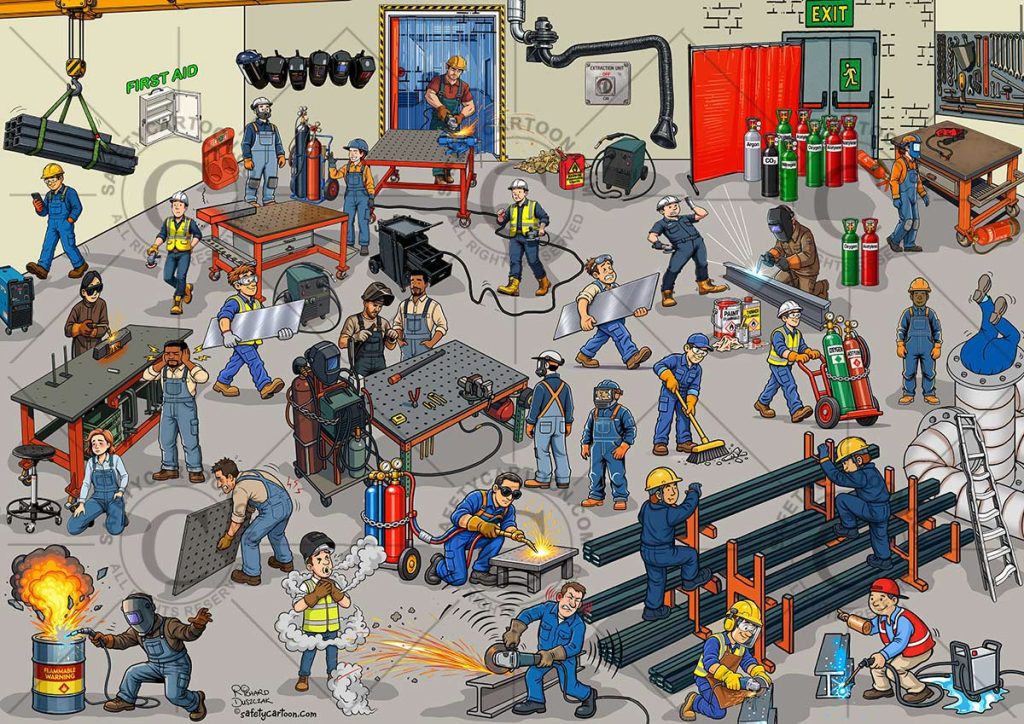
My latest welding hazard spotting cartoon brings a busy metal fabrication workshop into one detailed illustration. It’s designed to get your team looking, talking and thinking about the risks around them.
Some dangers will catch your eye straight away. Others need a closer look!
What would you tackle first?
Show the cartoon to your team and give them a few minutes to explore the scene.
They’ll find situations involving welding and grinding, gas cylinders, flammable materials, trailing cables, lifting operations and manual handling. There are also opportunities to discuss welding fumes, electrical safety, escape routes and protecting people working nearby.
But identifying a hazard is only the start.
Who could be harmed? What might happen? What would you change before allowing the work to continue?
Ask several people which situation they would tackle first. You may find they have quite different answers—and that’s a useful starting point for discussion.
Not everyone is doing something wrong
I’ve included positive practices too.
Look for workers using protective equipment, cylinders secured to a trolley and someone clearing debris from the floor.
Ask your team what these people are doing well. Then take the discussion a step further: does that positive feature make the whole activity safe, or are there other things to consider?
A worker may be wearing a welding helmet while someone nearby remains exposed to the arc. Spotting that connection helps participants think beyond their own immediate task.
A trainer’s answer sheet to support the discussion
The cartoon comes with an eight-page trainer’s answer sheet covering 32 location-based observation groups.
It includes:
- Clearly located observations and explanations of the risks.
- Suggested controls and practical improvements.
- Positive working practices to recognise.
- Ambiguous details that need checking rather than guessing.
- Discussion prompts and links to safety references.
The numbered groups help you navigate the picture. They are not a claim that there is one fixed number of hazards: some situations raise several issues, while others depend on information a cartoon cannot show.
How to use this welding hazard spotting cartoon in a toolbox talk…
You can use the illustration for welding safety training, workshop inductions, apprentice sessions or a refresher discussion with experienced staff.
Try this 15–20-minute exercise:
- Look: Give everyone a few minutes to examine the cartoon.
- Discuss: Ask each person or group to identify an immediate danger, a longer-term health risk and a positive practice.
- Improve: Choose practical controls for the situations they identify.
- Apply: Ask, “Is there anything similar in our workshop that we need to put right?”
Use the answer sheet to guide the conversation and explore different answers. The aim is to help people explain what they see and decide what safer working would look like.
An important note about gas-cylinder colours
Gas-cylinder colours and identification conventions vary between countries and suppliers. Always identify the contents using the supplier’s approved label and markings, never colour alone.
The colours in this cartoon are illustrative and should not be used as a gas-identification guide. This reminder is also included in the trainer’s answer sheet.
Download the cartoon and trainer’s answer sheet
The Welding Hazard Spotting Cartoon & Trainer’s Answer Sheet package is available for US$150 with a non-exclusive licence.
You receive:
- The original cartoon as a high-resolution JPEG, supplied without preview watermarks.
- A2 landscape artwork: 59.4 × 42 cm at 300 pixels per inch.
- The accompanying eight-page PDF trainer’s answer sheet.
This is a digital product; no physical poster is supplied. Please see the store listing for the permitted-use terms.
Buy the Welding Hazard Spotting Cartoon & Trainer’s Answer Sheet from my online store
Which situation would your team tackle first?
For further information on controlling welding fume, see the Health and Safety Executive’s guidance on protecting workers. Outside the UK, also consult your local workplace safety authority.
This illustration is an educational discussion resource. It supports, rather than replaces, task-specific training, workplace risk assessments and applicable local safety requirements.