Sparks are flying, steel is being moved and everyone is busy—but how safely are they working?
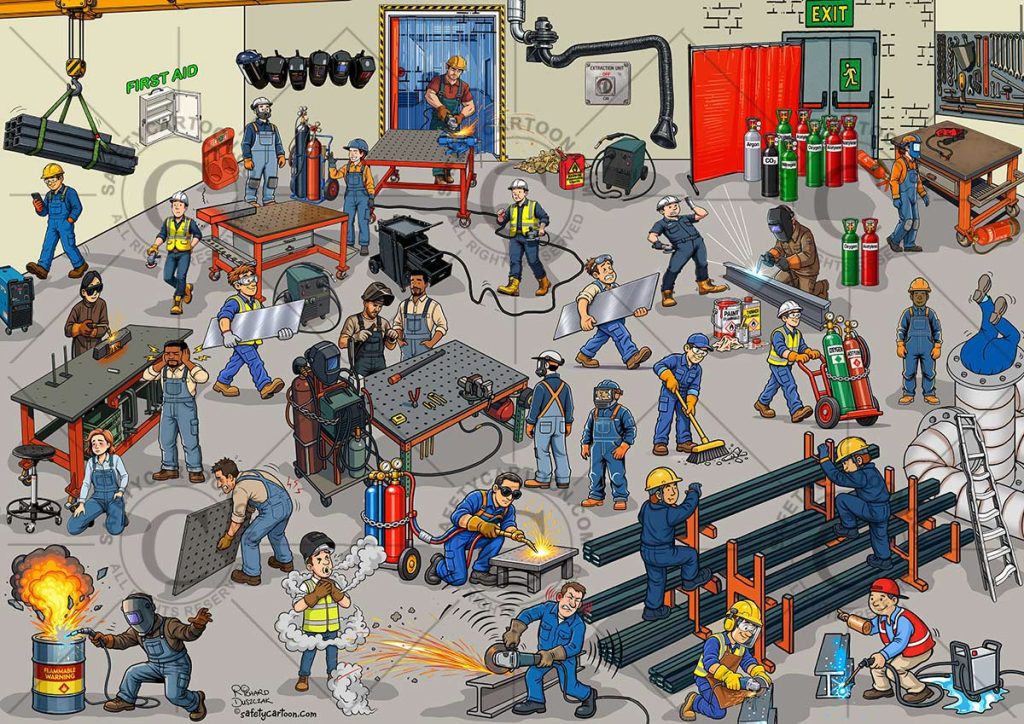
My latest welding hazard spotting cartoon brings a busy metal fabrication workshop into one detailed illustration. It’s designed to get your team looking, talking and thinking about the risks around them.
Some dangers will catch your eye straight away. Others need a closer look!
What would you tackle first?
Show the cartoon to your team and give them a few minutes to explore the scene.
They’ll find situations involving welding and grinding, gas cylinders, flammable materials, trailing cables, lifting operations and manual handling. There are also opportunities to discuss welding fumes, electrical safety, escape routes and protecting people working nearby.
But identifying a hazard is only the start.
Who could be harmed? What might happen? What would you change before allowing the work to continue?
Ask several people which situation they would tackle first. You may find they have quite different answers—and that’s a useful starting point for discussion.
Not everyone is doing something wrong
I’ve included positive practices too.
Look for workers using protective equipment, cylinders secured to a trolley and someone clearing debris from the floor.
Ask your team what these people are doing well. Then take the discussion a step further: does that positive feature make the whole activity safe, or are there other things to consider?
A worker may be wearing a welding helmet while someone nearby remains exposed to the arc. Spotting that connection helps participants think beyond their own immediate task.
A trainer’s answer sheet to support the discussion
The cartoon comes with an eight-page trainer’s answer sheet covering 32 location-based observation groups.
It includes:
Clearly located observations and explanations of the risks.
Suggested controls and practical improvements.
Positive working practices to recognise.
Ambiguous details that need checking rather than guessing.
Discussion prompts and links to safety references.
The numbered groups help you navigate the picture. They are not a claim that there is one fixed number of hazards: some situations raise several issues, while others depend on information a cartoon cannot show.
How to use this welding hazard spotting cartoon in a toolbox talk…
You can use the illustration for welding safety training, workshop inductions, apprentice sessions or a refresher discussion with experienced staff.
Try this 15–20-minute exercise:
Look: Give everyone a few minutes to examine the cartoon.
Discuss: Ask each person or group to identify an immediate danger, a longer-term health risk and a positive practice.
Improve: Choose practical controls for the situations they identify.
Apply: Ask, “Is there anything similar in our workshop that we need to put right?”
Use the answer sheet to guide the conversation and explore different answers. The aim is to help people explain what they see and decide what safer working would look like.
An important note about gas-cylinder colours
Gas-cylinder colours and identification conventions vary between countries and suppliers. Always identify the contents using the supplier’s approved label and markings, never colour alone.
The colours in this cartoon are illustrative and should not be used as a gas-identification guide. This reminder is also included in the trainer’s answer sheet.
Download the cartoon and trainer’s answer sheet
The Welding Hazard Spotting Cartoon & Trainer’s Answer Sheet package is available for US$150 with a non-exclusive licence.
You receive:
The original cartoon as a high-resolution JPEG, supplied without preview watermarks.
A2 landscape artwork: 59.4 × 42 cm at 300 pixels per inch.
The accompanying eight-page PDF trainer’s answer sheet.
This is a digital product; no physical poster is supplied. Please see the store listing for the permitted-use terms.
This illustration is an educational discussion resource. It supports, rather than replaces, task-specific training, workplace risk assessments and applicable local safety requirements.
Ladder safety at work isn’t always about using a ladder incorrectly. Sometimes, the danger comes from deciding not to use suitable access equipment at all.
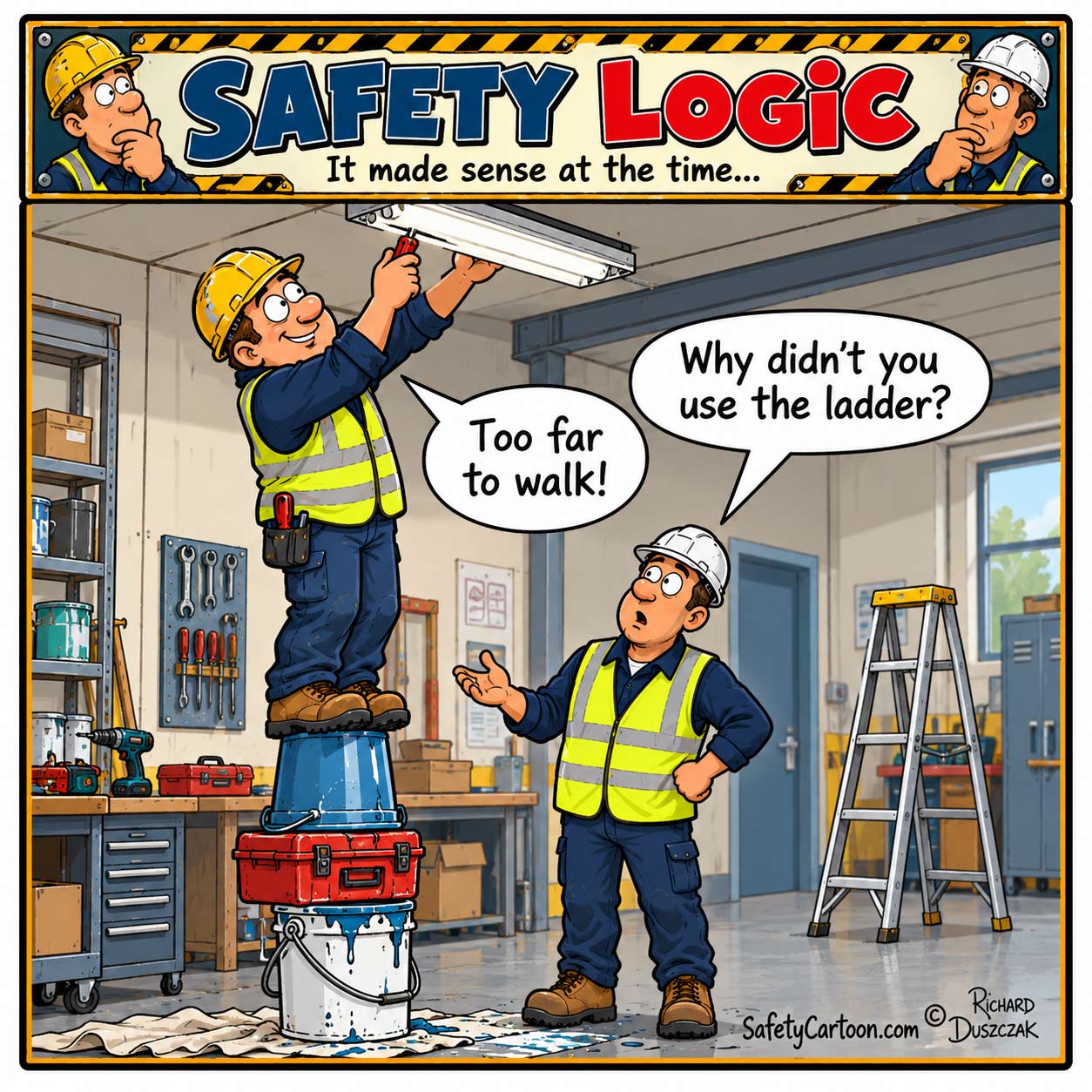
In this Safety Logic cartoon, a worker decides that walking across the workshop to collect a ladder is simply too much trouble. Instead, he balances on a precarious stack of paint containers and a toolbox to reach a ceiling light.
His explanation? “Too far to walk!”
It’s a ridiculous situation — but it illustrates a serious workplace safety issue: choosing convenience over suitable access equipment.
Why do workers take shortcuts?
Most workplace shortcuts aren’t necessarily taken with bad intentions.
Workers may be under pressure to finish a task, believe they have enough experience to judge the risk, or simply think that fetching the correct equipment will take too much time.
The trouble is that familiarity can create a false sense of security.
A task performed successfully a hundred times doesn’t automatically become safe on the hundred-and-first attempt.
And when it comes to ladder safety at work, choosing the wrong equipment — or avoiding the correct equipment altogether — can have serious consequences.
The dangers of makeshift working platforms
Standing on paint containers, toolboxes or other unsuitable objects might seem like a quick solution when something is just out of reach.
However, these objects are not designed to support someone working at height. They can shift, collapse or topple, potentially causing a serious fall.
Even a relatively short fall can result in significant injury.
Before beginning work at height, employers and workers should consider:
Is working at height necessary? Could the task be completed safely from ground level?
Is the access equipment suitable? Choose appropriate equipment based on the task, height, duration and risks involved.
Is the equipment stable? Ensure it is correctly positioned and used on a suitable surface.
Has the task been properly assessed? Even a five-minute job requires appropriate precautions.
Are there additional hazards? Working near electrical fittings may require isolation and other electrical safety measures.
The Health and Safety Executive (HSE) advises that work at height should be properly planned, supervised and carried out using suitable equipment.
Importantly, a ladder isn’t automatically the correct choice for every job. The safest access equipment depends on the circumstances and the findings of a suitable risk assessment.
The safest shortcut is often simply taking the time to do the job correctly.
Can a cartoon improve workplace safety awareness?
A humorous safety cartoon can highlight a potentially dangerous situation without immediately putting workers on the defensive.
Take our Safety Logic illustration, for example.
A worker has decided that balancing on a stack of paint containers and a toolbox is preferable to walking across the workshop to collect a perfectly good ladder.
His reasoning? “Too far to walk!”
It’s an exaggerated situation, but it illustrates how easily convenience can take priority over safety.
Instead of simply telling employees what they’re doing wrong, a cartoon encourages them to recognise the problem themselves.
Imagine showing this illustration during a toolbox talk and asking:
“Why is this worker taking such an unnecessary risk when suitable access equipment is only a short walk away?”
This simple question can open up a useful discussion about workplace shortcuts, risk awareness and the importance of choosing appropriate equipment.
Workers can identify the hazards, suggest safer alternatives and consider whether similar situations occur in their own workplace.
Making safety training more memorable
Workplace safety training doesn’t always need another lengthy presentation or a wall of written instructions.
Sometimes, a single well-chosen illustration can introduce an important conversation.
Our Safety Logic cartoons use humour, exaggeration and recognisable workplace situations to encourage employees to think about the decisions they make every day.
Topics such as ladder safety at work, working at height, manual handling and workplace housekeeping can all be explored through illustrated scenarios.
Cartoons can be particularly useful during toolbox talks, safety briefings, induction training and workplace awareness campaigns.
Because the best safety messages aren’t necessarily the longest ones.
They’re the ones people remember.
Looking for illustrated workplace safety training materials?
At SafetyCartoon.com, we create original health and safety cartoons, illustrated workplace scenarios and spot-the-hazards exercises for businesses, trainers and health and safety professionals.
Whether you’re preparing a toolbox talk, developing a training presentation or looking for engaging safety awareness materials, our illustrations can help bring your message to life.
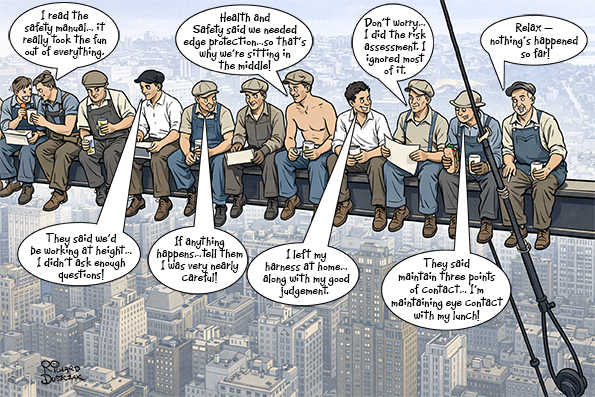
This skyscraper lunch photo cartoon reimagines the famous 1932 photograph of construction workers eating lunch high above New York City. It highlights how workplace safety standards have evolved dramatically over time.
Why this skyscraper lunch photo cartoon improves safety awareness
…
In 1932, eleven ironworkers sat casually on a narrow steel beam, hundreds of feet above New York City, eating their lunch as if it were the most ordinary thing in the world. No harnesses. No helmets. No visible safety precautions. Just sandwiches, cigarettes, and an extraordinary tolerance for risk.
The photograph, taken during construction of the Rockefeller Center, has since become one of the most iconic workplace images in history. What makes it so powerful isn’t just the height — it’s the attitude. The men appear relaxed, even comfortable. One reads a newspaper. Another lights a cigarette. Their body language suggests this wasn’t unusual. This was simply work.
Of course, looking at the image through modern eyes, it’s hard not to imagine what they might have been saying to each other. Perhaps a dry joke about gravity. A quiet comment about balance. Or maybe the kind of dark humour workers often use when facing genuine danger.
Today, the contrast couldn’t be greater. Harnesses, guardrails, risk assessments, and strict procedures are now standard. Not because regulations enjoy spoiling the fun — but because experience has taught us the cost of doing otherwise.
Safety rules are often written in response to real events, real injuries, and real losses.
This famous lunch break serves as a powerful reminder of how far workplace safety has come — and why it matters.
And perhaps also, a reminder that humour has always been part of how humans deal with risk… even when sitting 850 feet in the air.
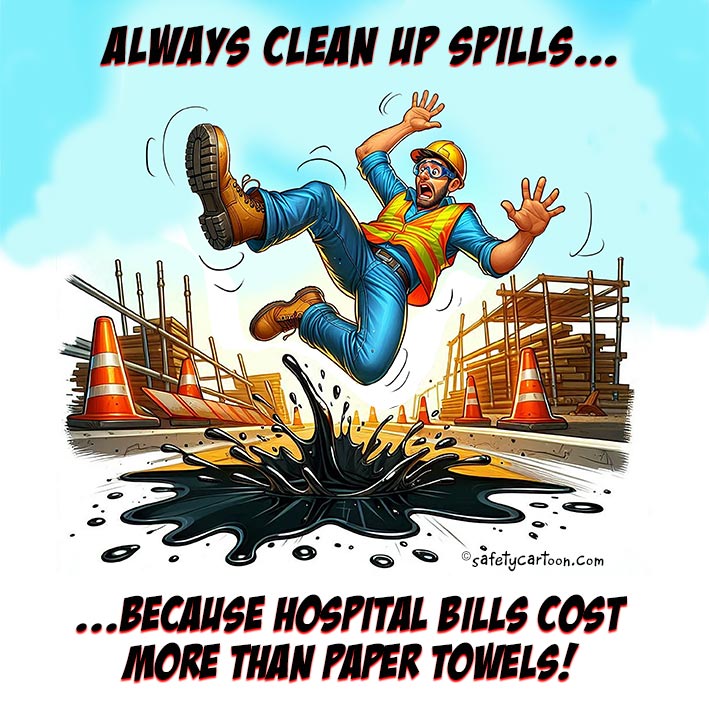
We’ve all seen it—someone walking confidently through a worksite or warehouse, only to suddenly slip and crash to the ground. It’s not just a cartoon gag—it’s a real workplace hazard that causes thousands of injuries every year.
This cartoon is a lighthearted reminder of a serious truth: a little spill can lead to a big accident. Whether it’s oil, water, grease, or even a dropped coffee, any liquid left on the floor becomes a potential slip-and-fall hazard. And what could’ve taken two seconds to wipe up could result in weeks off work, painful injuries, or worse.
Workplace safety doesn’t have to be complicated. Simple actions—like cleaning up after ourselves or placing warning signs—can prevent injuries, reduce downtime, and save businesses money. More importantly, they keep everyone safe.
At SafetyCartoon.com, we believe in using humor and health and safety cartoons to make safety messages stick. People are more likely to remember a funny visual than a dry memo on the noticeboard. That’s why cartoons like this one are such powerful tools for safety awareness.
So next time you spot a spill, don’t walk past it—wipe it up or report it! After all, a paper towel costs pennies… a trip to the emergency room? Expensive!.
🛠 Stay safe, stay alert, and keep those boots on the ground—not in the air!
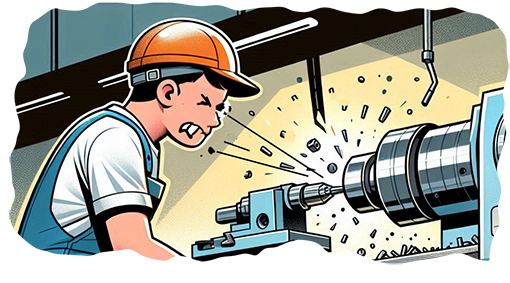
1. Protect Your Eyes from Debris – Safety glasses shield your eyes from flying particles, dust, and shavings, especially when working with wood, metal, or other materials.
2. Prevent Chemical Splashes – If you work with chemicals, safety glasses protect against harmful splashes that could cause burns, irritation, or blindness.
3. Block Harmful Radiation – Some safety glasses are designed to protect against UV rays, lasers, or intense light sources that can damage your vision.
4. Reduce the Risk of Eye Injuries – Workplace accidents involving tools, machinery, or even sports activities can lead to eye injuries, which safety glasses help prevent.
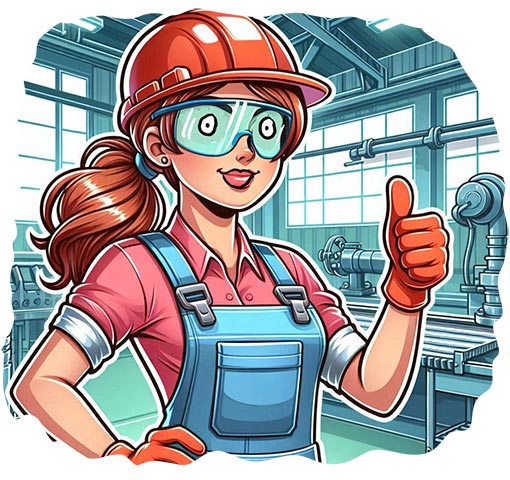
5. Compliance with Safety Regulations – Many industries require protective eyewear to meet health and safety standards, ensuring both personal and legal protection.